
Our services – for boards, for leaders, for organisations
Board effectiveness reviews

Socia specialises in carrying out Board Effectiveness Reviews with organisations and businesses, often with complex ownership structures including Government owned businesses, arms-length bodies, privately held organisations, joint ventures, mutuals, and charities. We use the most appropriate governance code to meet the needs of each Board. This is most often the FRC UK Corporate Governance Code, but also the Charities Governance Code, the Wates Principles, and the QCA Code along with Cabinet Office guidelines when required.
Our aim is always to help Board members to develop their individual and collective capability to scrutinise, govern and assure the sustainable health of their business. Our reviews are value adding and designed to go beyond a mere assessment of compliance to enable Boards to actively improve their performance and delivery to stakeholders.
We are founder members of the Board Effectiveness Guild a membership organisation dedicated to sharing best practice and contributing to thought leadership in Board reviews.
The Socia approach to Board effectiveness reviews is:
- Time & cost efficient – the evaluation process is designed to make the minimum demands on the valuable time of Board members. Background and factual paper-based information is provided by the Board Secretary to ensure that the limited time spent interviewing each Board member is focused on the issues of highest significance
- Collaborative and constructive – we focus on providing feedback and advice to the whole Board in a way which will enable it to improve its own performance. Feedback needs to be handled sensitively and improvement plans need to be pragmatic and easy to implement. We also leave Boards with the tools to carry out their own self evaluations using the same approach in the future.
- Compliant – we believe in the value of basing a Board evaluation on a common standard so that all key issues of good governance are covered and Directors who sit on several Boards in different sectors can use a common language when discussing Board improvement. The UK Governance Code is a well-established benchmark and we believe its principles can be usefully applied to Boards in other sectors, but we also work with the charities code and the cabinet office guidance as appropriate. If you would like to read a copy (PDF) of the code click here.
Comparing the experiences of Board members from different sectors

From December 2014 to February 2015 we surveyed 116 members of private sector, charity and public sector Boards – split 30% from the private sector, 33% charity/mutual and 37% public sector. The aim of the survey was to identify common issues and specific concerns, and to see whether Board improvement mechanisms, such as external evaluation using the UK Corporate Governance Code, could be transferred from one sector to another.
“Greater awareness and appreciation of what a Board is there to do – and not!” – charity sector
Boards can appear quite different…
PLC / private company |
Charities and mutuals |
Public sector |
|
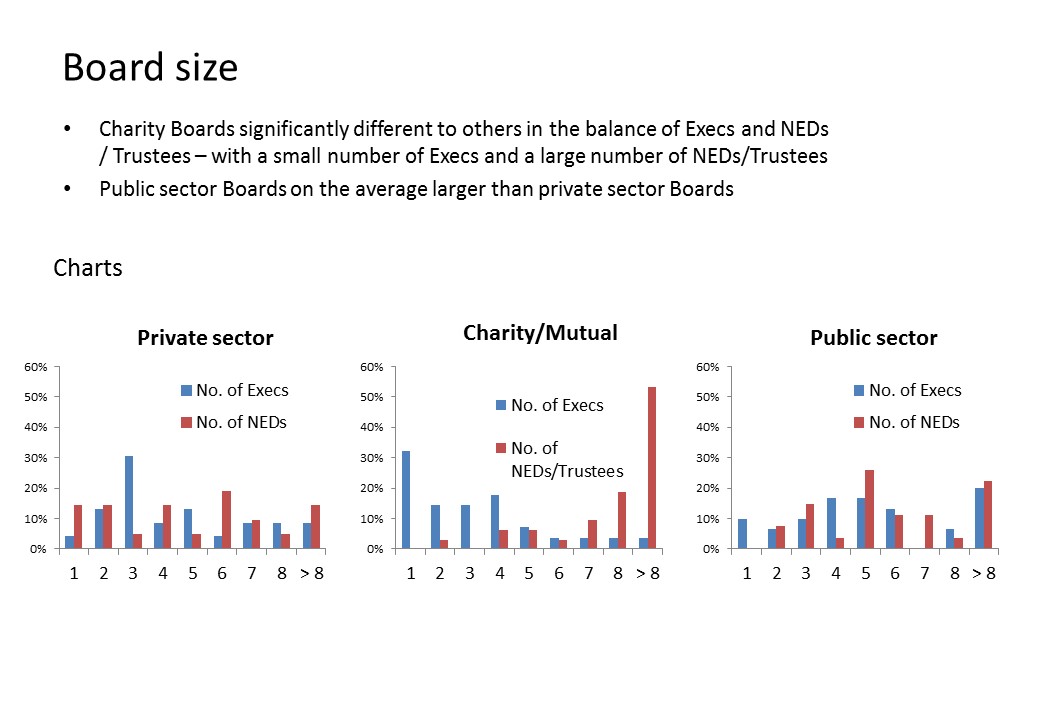
| Composition: Charities and mutuals biggest Boards by far 8 or more NEDs/Trustees: • Charity/mutual 72% • Public sector 26% • Private/PLC 19%Only 1 Exec member: • Charity/mutual 32% • Public sector 4% • Private/plc 10% |
• Smaller Boards with a balance between executives and non-executives (Ave. = 5 Execs & 5 NEDs) • Adhere to the requirements of the UK governance code • Used to reporting the results of their performance reviews and development plans (Of those Boards that had had an evaluation in the last 5 years, 90% had published a Board development plan) |
• Large Boards often with 8 or more NEDs /Trustees (many elected) and a very small number of executives • The composition of these Boards makes the chairman’s role more challenging. And only 19% reported having a SID or equivalent to assist the chairman • Efficient decision making is a challenge as it involves so many Board members (who are often volunteers) |
• Large Boards with a greater number of appointed executive members • More variation in the size and composition of public sectors Boards than others • Board evaluation tends to be more of an internal process. (Only 50% of evaluations had used an external body to conduct the process) |
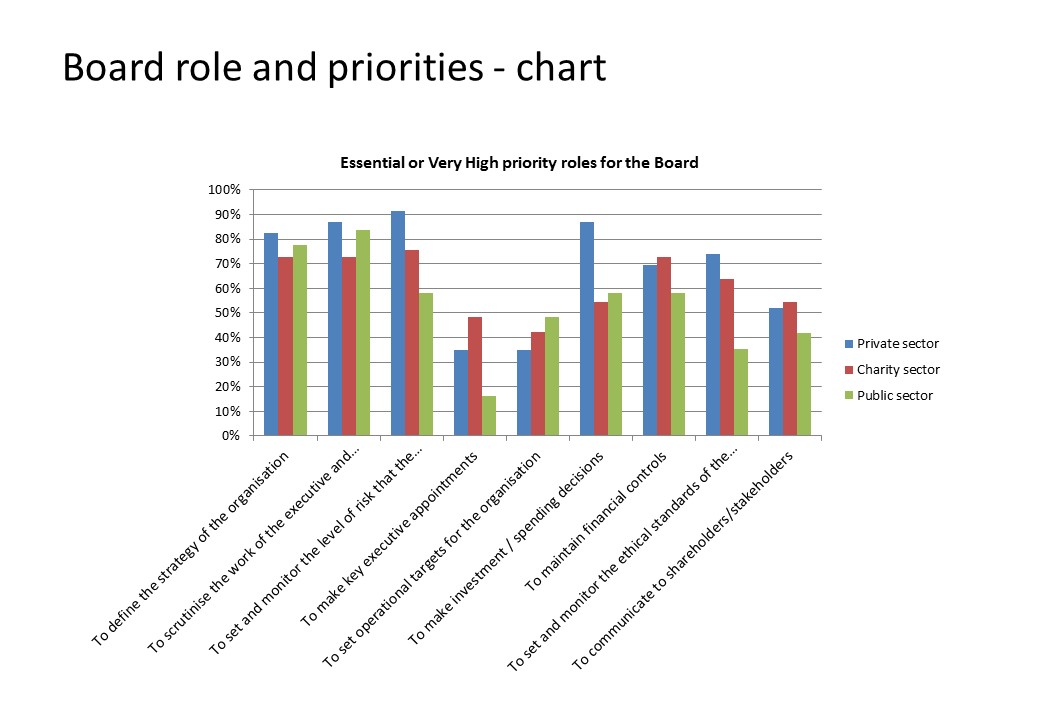
| Priorities: Public sector out of step with other Boards Risk management: • Private/plc 91% high priority • Charity/mutual 76% • Public sector 58% • Private/plc 74% high priority • Charity/mutual 64% • Public sector 35% |
• Making investment decisions and setting /monitoring the level of risk that the organisation will accept are high priorities compared to other Boards • Setting operational targets is less of a high priority for these Boards (35% against 42% charity, 48% public sector) |
• Making key executive appointments is seen as more of a high priority for these Boards (48% against 35% private 16% public sector) • Making investment and spending decisions is less of a high priority compared with private sector Boards (55% against 87% for PLC /private sector) |
•Setting operational targets for the organisation is a high priority compared with the other Boards • The wider governance landscape is more complex for these Boards who need to manage their responsibilities in conjunction with many other public bodies and political institutions |
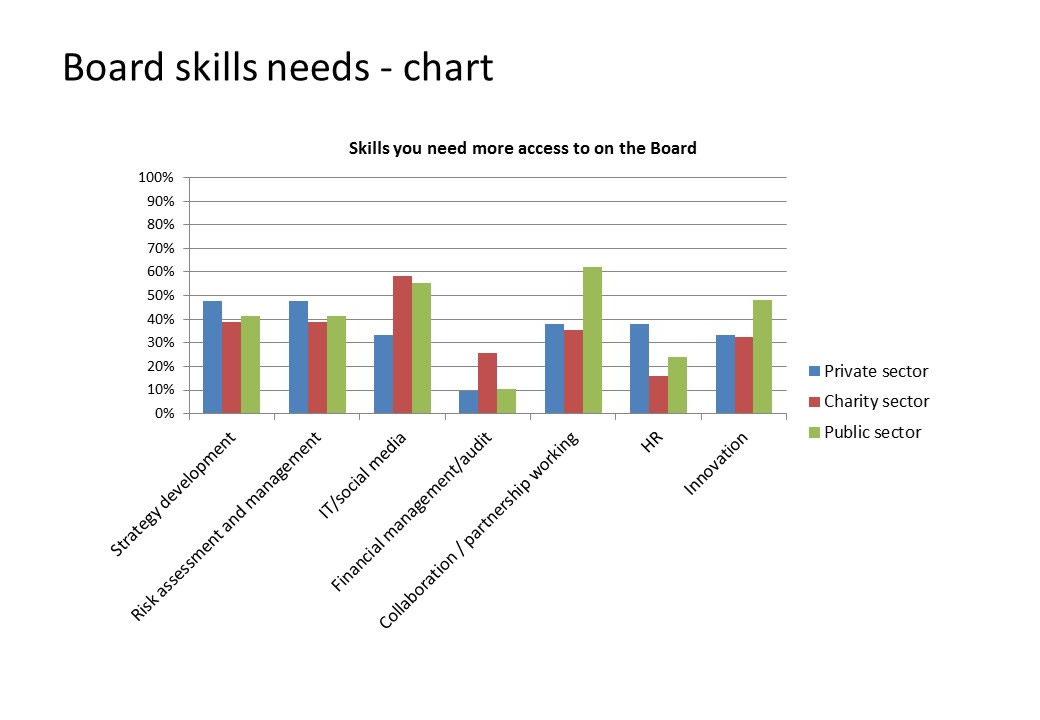
| Additional skills: Public sector looking for collaboration skills Need for more collaboration /partnership working skills: • Public sector 62% • Private/plc 38% • Charity/mutual 36% |
• HR skills are a particular need for these Boards compared to the other two sectors (38% compared to 16% charity, 24% public sector) |
• Financial management /audit skills were seen as a need by these Boards compared with other sectors (26% as against 9% for private/plc and 10% for public sector) |
• These Boards want access to a greater range of additional skills, e.g. collaboration /partnership working, IT /social media and innovation skills |
“Working together as a team rather than a group of individuals” – private sector
But all Boards are still trying to achieve the same things
We see more similarities than differences. For example respondents from all three sectors rated strategy development, and scrutiny of the work of the Executive as the highest priority responsibilities for a Board. And all three sectors recognised the need to evaluate and develop Board performance. However, more notable is that all Boards highlight the dynamics of Board operation as essential to improve their performance; whether that is about increasing diversity in Private sector Boards, building a better rapport with executives in Charity Boards or encouraging constructive challenge in Public sector Boards. But only a minority of Charity and Public sector Boards have appointed a Senior Independent Director or equivalent to be responsible for reviewing/improving performance of the Chair and the Board.
“…A commitment to reviewing its own performance on an ongoing basis and acting on what it learns” – charity sector
It’s time for one evaluation framework for all Boards
Increasingly stakeholders/shareholders demand that all Boards have a transparent process to improve their performance. The Financial Reporting Council (FRC) who own and develop the UK Corporate Governance Code (the Code) understands this and the FRC will continue to increase their expectations of the performance of the Boards in the Private sector with mandatory external evaluations carried out against the Code. With common experience and priorities, one approach to performance evaluation could and should work in most Boards. Many NEDs on Private sector Boards also sit on Charity and Public sector Boards too, so they are already familiar with the requirements of the Code. The ‘Comply or Explain’ approach adopted by the Code allows Boards to address the issues that are unique to their own circumstances.
The principles of the Code encourage transparency, diversity and self-criticism – all necessary steps to help Boards improve and meet the requirements of their stakeholders. Making the use of the UK Corporate Governance Code mandatory for all Boards would be a tried and tested approach and one that we know can work.
“…greater clarity on roles and responsibilities, the purpose of the board and how it fits with the rest of the public sector/political governance machinery” – public sector
Developing collaborative leaders

- Build relationships – widely and deeply – with people from different backgrounds and with different perspectives. Building diverse relationships takes time and effort. It’s easier for a leader to focus in on their own team and a trusted circle of established advisors – but that’s not good enough
- Handle conflict – All the successful collaborative system leaders we’ve worked with are comfortable in dealing with conflict. It’s not that they seek out a fight – but rather that by listening hard for dissenting voices and being unafraid to dig out areas of disagreement early they’re able to make better choices and avoid further combat down the line
- Share control – In an interconnected world there is rarely single point of control – and if a leader believes they are totally in control of a complex system they’re living an illusion. Collaborative leaders have the interpersonal skills and the system governance processes they need to hold responsibility, but share control.
We have developed a number of tools to help collaborative leaders develop their capabilities. These include 360 feedback tools; collaborative leadership self-assessment questionnaires and collaboration profiles based on a knowledge of your Myers Briggs Type (MBTI).
Sample MBTI and collaboration profile
ESTJs and collaboration
When working in collaborative groups, ESTJs are usually keen to have clear, logical goals, preferably expressed in measurable terms. They are likely to contribute to the process of developing shared objectives by being brisk, factual and task-focused. They typically have a talent for organising people and things in practical ways, and will push for general aspirations to be translated into specific actions. They enjoy planning ahead, using past experience to guide their decisions, and will be quick to see gaps and flaws in the planning process. Their focus tends to be more on present and past realities than on future possibilities, and it may require some effort for them to step back and look more widely and at the longer-term. They prefer to keep discussions with others as focused as possible, avoiding discussion of non-relevant topics. They may become impatient with others who want to talk about issues of mission and values, especially if they make little reference to current reality.
Once a plan is in place, they will be very determined in following through and holding people accountable for progress. They are often astute in recognising where there are technical skills gaps, and will be firm about making plans to improve such skills, or if necessary, to replace people whose skills do not fit the role
ESTJs have a style of communication that is usually straightforward, no-nonsense and business-like. They tend to have little patience for small-talk, regarding it as pointless and a waste of time, since no real information is exchanged. They often have firm opinions and do not hesitate to voice these. Given the choice of truth or tact they tend to favour truth, with the advantage that others know where they stand, but the potential problem of hurt feelings. ESTJs find it difficult to understand why people should be offended by being told the truth, particularly when they have asked for an opinion. They enjoy logical debate, and will expect other parties to put their views as firmly as they do. However, once they have decided, they can be prone to seeing things in black and white terms and believing that their views are obviously correct. It can be hard for them to listen with an open mind when people want to re-open a debate after a decision has been made.
Collaborative leadership style
Because ESTJs show confidence in deciding, planning and organising, they often end up in positions of leadership. They are typically comfortable with authority and regard hierarchical systems as logical and efficient ways to work through people. ESTJ leaders tend to use consistent principles in dealing with people, and to be fair in the sense of treating everyone equally. It is not so natural for them to pay attention to the needs and feelings of others. If people are in difficulty, they are likely to demonstrate caring by helping them sort out their problems, rather than by spending a lot of time in empathic listening.
ESTJs’ natural style of leadership is one that has been encouraged and reinforced in many traditional organisations, and their clear, firm style is often helpful for getting things done on time and in a systematic way. It may be something of a challenge to ESTJs to operate in a more complex collaborative system, where lines of authority are ambiguous. They will thus prefer collaboration to take place within a structure that specifies who is responsible for what. They will find it difficult if someone interferes with their plans once decisions have been made, particularly if this results in confusion and delay
Preferred ways of working
A high degree of role clarity will be helpful for ESTJs. They will be happy to delegate tasks to others, as long as they complete these on time and in the way the ESTJ expects. When passing on tasks to others they will usually be thorough in explaining what needs to be done, and may be impatient if the person wants to do things in a different way. When working with another party who prefers more freedom in the way they work, ESTJs may need to be careful to specify only what is necessary in terms of required outcome, leaving some room for creativity of process.
©Socia and Sally Carr
Collaboration between organisations

- get new consortia and other multi-party groups off on the right foot – building the necessary governance and establishing levels of knowledge about each other’s culture and ways of working
- regularly evaluate the state of collaboration in multi-party systems and focus improvement efforts on critical business areas. Tracking progress using our PPI tool
- mediate in situations of conflict and help to reset damaged relationships.
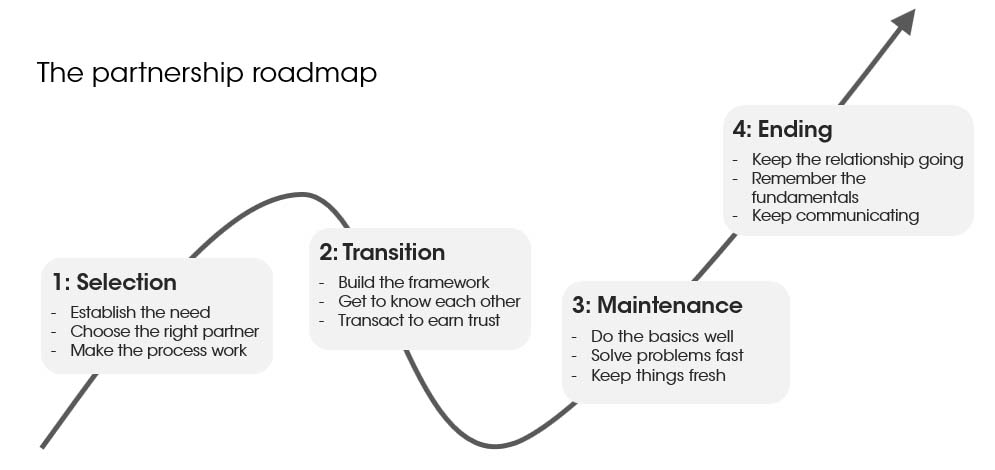
Any business relationship will go through different stages, each with their own ups and downs. Based on our experience of working with diverse organisational groups that need to collaborate more effectively we have developed a partnership roadmap which helps diagnose the symptoms you may see as you move from stage to stage – and how best to react to them.
Partnering Performance Indicator
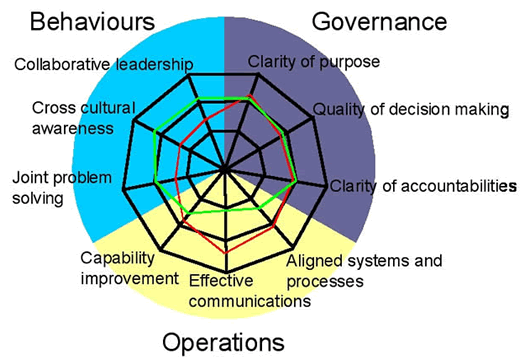
The PPI is the foundation of Socia’s approach to partnership development allowing individuals and organisations to identify areas of strength and weakness and to compare their assessment with that of other partners.
This tool expands the three fundamental components of partnering into nine key indicators of effective partnering. Each of these indicators is measured by the PPI.
Governance
- Clarity of purpose. Does each party believe they are working to aligned goals and is the aim of partnership clear to all
- Quality of decision making. Are the decision making processes clear to all and are the right people involved
- Clarity of accountabilities. Does everyone understand who is accountable for what?
Operations
- Aligned systems and processes. Is the performance data of the partnership transparent with rewards and incentives clear to all
- Effective communications. Are meetings and communications focused on the right issues and are all parties kept informed of developments in the partnership?
- Capability improvement. Are all partners getting access to the necessary skills and is the partnership investing to fill skill gaps and to develop future capability?
Behaviours
- Collaborative leadership. Do the leaders of the partnership work effectively together for the good of the partnership?
- Cross cultural awareness. Do people understand the differences in culture across the partnership and are they willing to adapt their ways of working to suit others?
- Joint problem solving. Do people work together to solve performance problems and to come to the best decisions for the benefit of the whole partnership?
These key elements inform the solutions we co-create with our clients, and provide the basis for measurement using the Socia toolset.
Sample PPI output
Section 1: responses from the partnership
Overall number of responses from your the partnership = 38
Average partnership rating from the partnership as a whole = 4.4
Comparison of ratings by category
Section 2: responses from your own part of the organisation
Overall number of responses from your own part of the organisation = 8
Average partnership rating from your own part of the organisation = 4.3
Ratings by category
| Categories | Average rating | Highest | Lowest |
| Clarity of purpose | 5.2 | 6 | 2 |
| Quality of decision making | 4.1 | 5 | 2 |
| Clarity of accountabilities | 3.6 | 5 | 1 |
| Aligned systems and processes | 5 | 6 | 3 |
| Effective communications | 4.4 | 6 | 2 |
| Capability improvement | 3.8 | 5 | 1 |
| Collaborative leadership | 4.6 | 6 | 3 |
| Cross cultural awareness | 3.2 | 5 | 1 |
| Joint problem solving | 3.7 | 5 | 1 |
